


 15 / 43

AL MAZAYA HOLDING COMPANY K.S.C. AND ITS SUBSIDIARIES
NOTES TO THE CONSOLIDATED FINANCIAL STATEMENTS
For the year ended 31 December 20 II
MAZAYA
MM10trAD
3.
BASIS OF PREPRATION AND SIGNIFICANT ACCOUNTING POLICIES (CONTINUED)
Goodwill
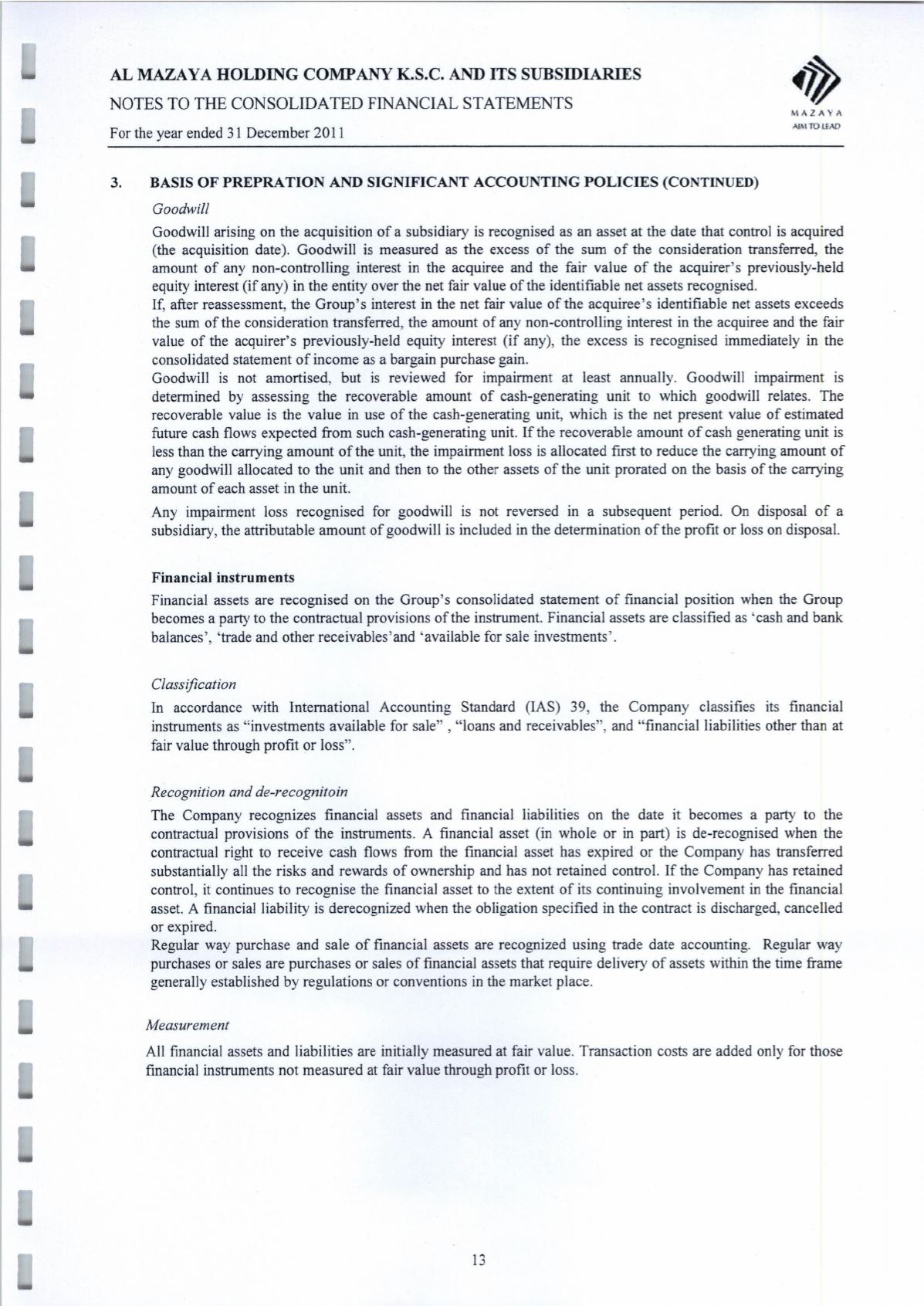
Goodwill arising on the acquisition of a subsidiary is recognised as an asset at the date that control is acquired
(the acquisition date). Goodwill is measured as the excess of the sum of the consideration transferred, the
amount of any non-controlling interest in the acquiree and the fair value of the acquirer's previously-held
equity interest (if any) in the entity over the net fair value of the identifiable net assets recognised.
If, after reassessment, the Group's interest in the net fair value of the acquiree ' s identifiable net assets exceeds
the sum of the consideration transferred, the amount of any non-controlling interest in the acquiree and the fair
value of the acquirer's previously-held equity interest (if any), the excess is recognised immediately in the
consolidated statement of income as a bargain purchase gain.
Goodwill is not amortised, but is reviewed for impairment at least annually. Goodwill impairment is
determined by assessing the recoverable amount of cash-generating unit to which goodwill relates. The
recoverable value is the value in use of the cash-generating unit, which is the net present value of estimated
future cash flows expected from such cash-generating unit. If the recoverable amount of cash generating unit is
less than the carrying amount of the unit, the impairment loss is allocated first to reduce the carrying amount of
any goodwill allocated to the unit and then to the other assets of the unit prorated on the basis of the carrying
amount of each asset in the unit.
Any impairment loss recognised for goodwill is not reversed in a subsequent period. On disposal of a
subsidiary, the attributable amount of goodwill is included in the determination of the profit or loss on disposal.
Financial instruments
Financial assets are recognised on the Group's consolidated statement of fmancial position when the Group
becomes a party to the contractual provisions of the instrument. Financial assets are classified as 'cash and bank
balances', 'trade and other receivables' and 'available for sale investments'.
Classification
In accordance with International Accounting Standard (lAS) 39, the Company classifies its financial
instruments as "investments available for sale" , "loans and receivables", and "financial liabilities other than at
fair value through profit or loss".
Recognition and de-recognitoin
The Company recognizes financial assets and financial liabilities on the date it becomes a party to the
contractual provisions of the instruments. A financial asset (in whole or in part) is de-recognised when the
contractual right to receive cash flows from the financial asset has expired or the Company has transferred
substantially all the risks and rewards of ownership and has not retained control. If the Company has retained
control, it continues to recognise the financial asset to the extent of its continuing involvement in the financial
asset. A financial liability is derecognized when the obligation specified in the contract is discharged, cancelled
or expired.
Regular way purchase and sale of fmancial assets are recognized using trade date accounting. Regular way
purchases or sales are purchases or sales of financial assets that require delivery of assets within the time frame
generally established by regulations or conventions in the market place.
Measurement
All financial assets and liabilities are initially measured at fair value. Transaction costs are added only for those
fmancial instruments not measured at fair value through profit or loss.
13