


 21 / 23

Mazaya Monthly Real Estate Report -
Week 5 - May 2016
21
Such demands have, historically,
meant higher costs to the developer;
however, increasingly, it has become
possible to capitalise on the advances
in the development of both sustainable
and recyclable substances used for
construction. Materials and designs
more suited to hot weather, energy
efficiency, and offer reduced impact on
the immediate environment are now
just as important to homeowners as
aesthetically attractive living spaces.
Al Mazaya’s Report can reveal that
urban design and planning are among
the key factors that attract investors to
a real estate market and its domestic
infrastructural developments. Planning,
research and study are the fundamental
building blocks for any large-scale
development; however, governments,
end-users
and
investors
are
increasingly demanding that projects
offer long-term sustainability solutions,
energy efficiency, and environmentally
friendly architecture and landscaping.
Al Mazaya’s Report further points out
that while urban areas are expected to
grow in number – worldwide – over the
next twenty years, the drive to construct
“green cities” is now very much on
the agenda of many governments.
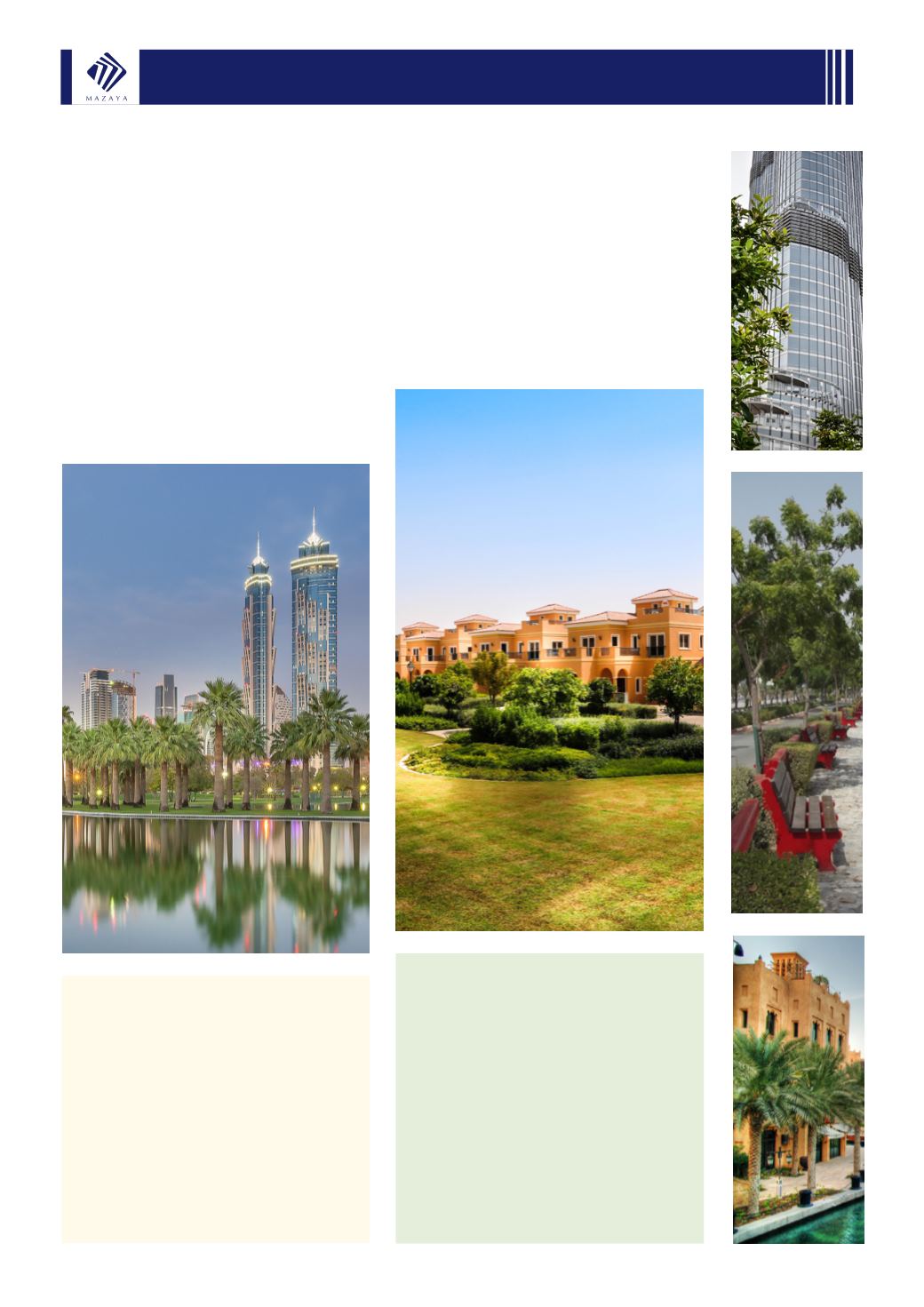
Allocating areas for gardens and urban
landscaping can make cities less
contaminated by pollution and help
protect local habitats and wildlife. Such
measures are of significant importance
in the likes of China and India, where
cities are expected to grow at a rapid
rate throughout the 21st century.
In this respect, Al Mazaya Holding's
Weekly Real Estate Report points out
that maintaining natural habitats, in
the face of urban growth to match
population trends, is a major challenge.
This is also a problem for countries that
have an abundance of natural greenery
and rainfall; however, these challenges
are doubled when we talk about cities
constructed in arid, desert climates.
While the GCC region remains a popular
destination for high volumes of real estate
investment,conformingtoglobalstandards
on the environmentally sustainable
construction of new urban developments
continues
to
present
challenges.