


 19 / 38

AL MAlAYA HOLDING COMPANY
K.S.C.
(CLOSED) AND SUBSIDIARIES
NOTES TO THE CONSOLIDATED FINANCIAL STATEMENTS
DECEMBER 31, 2007
(All amounts are in Kuwaiti Dinars)
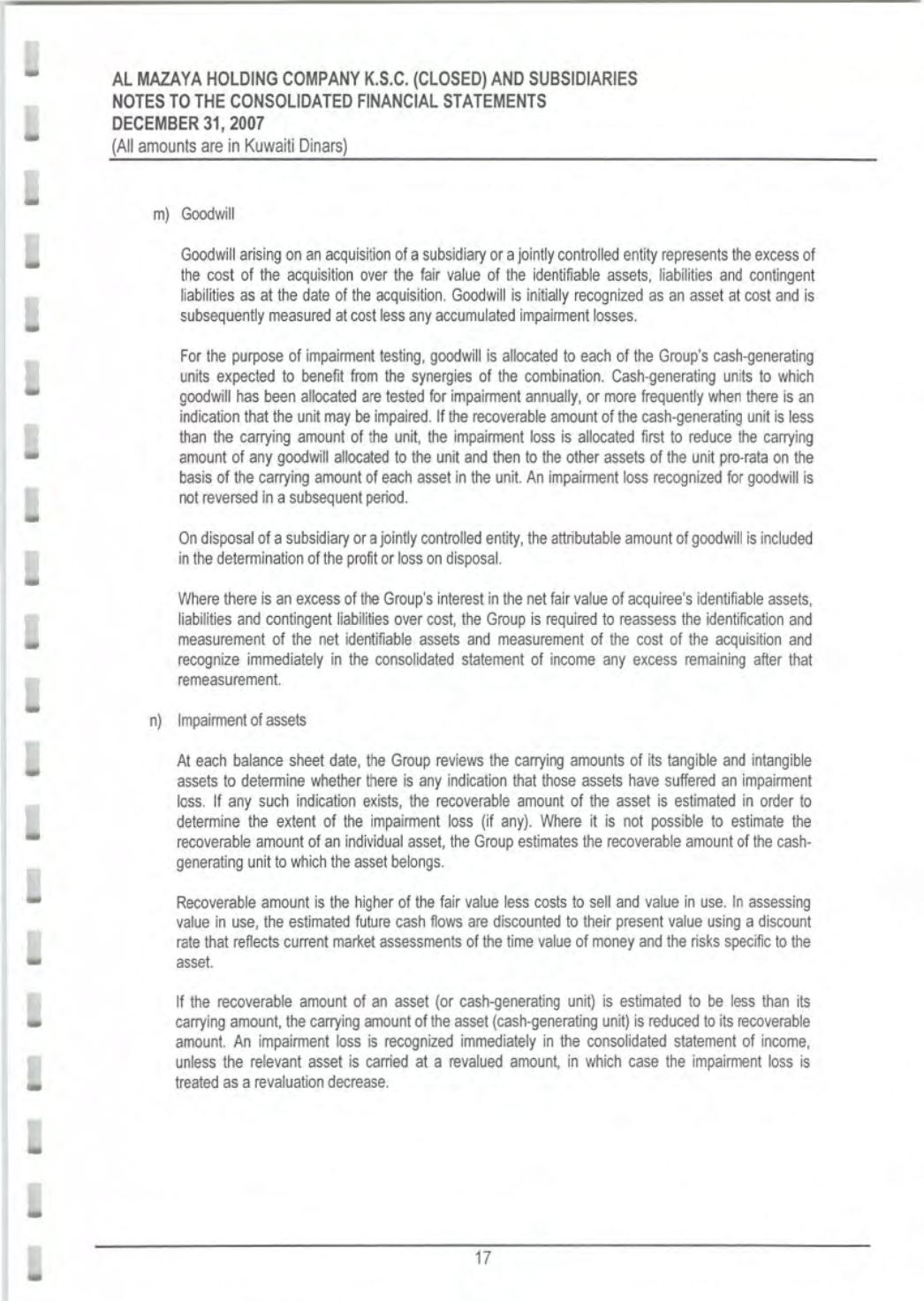
m) Goodwill
Goodwill arising on an acquisition of a subsidiary or a jointly controlled entity represents the excess of
the cost of the acquisition over the fair value of the identifiable assets, liabilities and contingent
liabilities as at the date of the acquisition. Goodwill is initially recognized as an asset at cost and is
subsequently measured at cost less any accumulated impairment losses.
For the purpose of impairment testing, goodwill is allocated to each of the Group's cash-generating
units expected to benefit from the synergies of the combination. Cash-generating units to which
goodwill has been allocated are tested for impairment annually, or more frequently when there is an
indication that the unit may be impaired. If the recoverable amount of the cash-generating unit is less
than the carrying amount of the unit, the impairment loss is allocated first to reduce the carrying
amount of any goodwill allocated to the unit and then to the other assets of the unit pro-rata on the
basis of the carrying amount of each asset in the unit. An impairment loss recognized for goodwill is
not reversed in a subsequent period.
On disposal of a subsidiary or a jointly controlled entity, the attributable amount of goodwill is included
in the determination of the profit or loss on disposal.
Where there is an excess of the Group's interest in the net fair value of acquiree's identifiable assets,
liabilities and contingent liabilities over cost, the Group is required to reassess the identification and
measurement of the net identifiable assets and measurement of the cost of the acquisition and
recognize immediately in the consolidated statement of income any excess remaining after that
remeasurement.
n) Impairment of assets
At each balance sheet date, the Group reviews the carrying amounts of its tangible and intangible
assets to determine whether there is any indication that those assets have suffered an impairment
loss. If any such indication exists, the recoverable amount of the asset is estimated in order to
determine the extent of the impairment loss (if any). Where it is not possible to estimate the
recoverable amount of an individual asset, the Group estimates the recoverable amount of the cash-
generating unit to which the asset belongs.
Recoverable amount is the higher of the fair value less costs to sell and value in use. In assessing
value in use, the estimated future cash flows are discounted to their present value using a discount
rate that reflects current market assessments of the time value of money and the risks specific to the
asset.
If the recoverable amount of an asset (or cash-generating unit) is estimated to be less than its
carrying amount, the carrying amount of the asset (cash-generating unit) is reduced to its recoverable
amount. An impairment loss is recognized immediately in the consolidated statement of income,
unless the relevant asset is carried at a revalued amount, in which case the impairment loss is
treated as a revaluation decrease.
17